Justifiable Fabric
The Justifiable Fabric is the append-only assurance ledger and supervision runtime behind /layered engagements.
It is not the global semantic source of truth. Canonical semantic identity belongs to JAI and domain profiles. Fabric records point to the relevant canonical object identities/hashes and record who did what, under which contract, with which evidence/review/authority state.
What the operator uses; what the runtime does
| In a Claude/Codex conversation | Behind the scenes |
|---|---|
Start /layered <intent> or $workflow-layered <intent>. |
The orchestrator creates a Fabric engagement, records intent, issues typed contracts and delegates the work. |
Ask for blockers, evidence or an independent /fabric-report / $workflow-fabric-report. |
fabric-auditor calls fabric.py read-only status/report/verification operations and cites actual record IDs. |
| Supply missing material or respond to an escalation. | The agent records failed attempts, reviews and bounded recovery; the deterministic runtime rejects invalid transitions. |
| Make L0 decisions using the provider's trusted mechanism. | Claude may present an interactive gate; Codex intentionally cannot perform the authority command and must give it to the human for separate execution. |
No normal manual Fabric setup is required. The Python snippets below are the underlying maintainer/implementation API and show how a recorded event is reproduced or investigated. Their presence does not mean a user must run them after invoking the provider skill. The runtime is invoked by model-orchestrated tool calls; missing execution or blocked permissions must be surfaced as unresolved work, not reported as success. See the operator journey and human authority.
What it records
A fabric engagement can contain typed records for:
- operator intent and requirements;
- adjacent-layer contracts;
- product fragments/candidates;
- evidence and evidence-file digests;
- reviews and constraints;
- explicit failures;
- conflicts and contradictions;
- escalations and reformulations;
- human authority decisions;
- release decisions and invalidations;
- execution/assurance lineage.
Records are append-only and hash-chained. Corrections create new records rather than rewriting earlier history.
Layer model
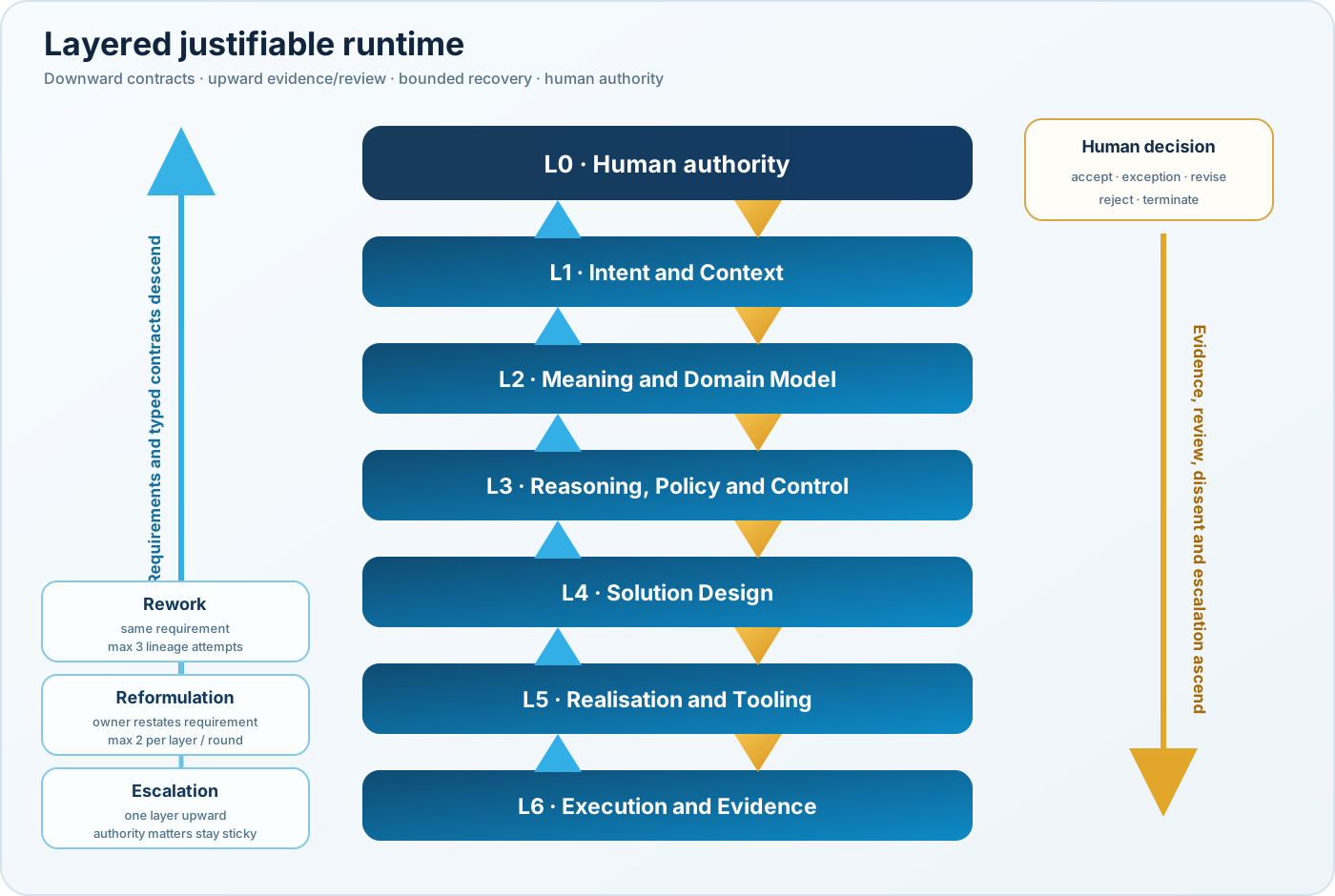
L0 is Human Authority and is not part of the six-layer JAI core.
Adjacent-layer transformation is the default and enforced relation rules prevent a lower-layer product from being silently promoted across intermediate transformation boundaries.
Where the record lives
Default engagement record:
Override the record directory with FABRIC_HOME.
Authority key:
The authority key is managed/read by the Fabric runtime and protected from ordinary model-driven file reads/writes by the managed authority hook.
Context binding
A layer agent is intended to receive the rendered contract packet rather than the full unconstrained conversation. The packet carries a SHA-256 context_digest; ingestion rejects a result that declares a different digest.
This creates an auditable intended context boundary. It does not by itself prove that an external provider received no additional context — that remains a provider/host integration property.
Review before promotion
The upward path is a review path. A layer can build upward only from child fragments it has accepted. This prevents a summariser from laundering an unresolved lower-layer result into a stronger state merely by rewriting it.
Strict release mode distinguishes direct/evidenced support from weaker relations such as correlation or resonance.
Bounded supervision
The deterministic policy kernel is stored in:
The policy treats retryable failures, contradictions, budget exhaustion and operator-boundary cases differently. A model cannot grant itself additional autonomous attempts.
Default bounds:
- rework:
3per contract lineage; - reformulation:
2per layer per round; - contracts:
40per round; - human revision rounds:
5before explicit override; - shared episode transitions:
120.
See Running a layered justifiable engagement for the full recovery ladder.
Rework is not reformulation
Rework is another attempt at the same requirement. The runtime prevents it from changing material semantic fields such as what, why, evidence obligation and escalation condition.
Reformulation creates a new requirement generation and can only be issued by the layer that owns/issued the strained requirement.
Escalation moves an unresolved issue one layer upward. Authority matters such as risk acceptance cannot be downgraded into a reformulatable technical problem.
Evidence drift and invalidation
When an evidence file is recorded, the Fabric stores its digest. If the file later changes, strict release eligibility fails.
When a depended-on Fabric record is superseded or invalidated, the orchestrator (or a maintainer performing recovery) calls the internal API:
python3 ~/.ai/it-role-house/fabric/fabric.py invalidate <engagement> \
  --changed <record-id> --reason '<reason>'
Affected dependent outputs receive blocking conflicts until they are re-evaluated.
Release eligibility
Finishing generation is not release. The release gate requires, among other things:
- strict justifiability of the product;
- accepted review state;
- appropriate L0 authority acceptance for the consequential product;
- intact fabric hash chain and well-typed relations;
- no current evidence drift/blocking invalidation.
Internal checks run by an agent or maintainer (the ordinary operator asks for $workflow-fabric-report or /fabric-report instead):
python3 ~/.ai/it-role-house/fabric/fabric.py verify <engagement>
python3 ~/.ai/it-role-house/fabric/fabric.py justify <engagement> --strict
python3 ~/.ai/it-role-house/fabric/fabric.py release <engagement> <fragment-id>
Human-friendly and direct inspection
Claude:
Codex:
Direct CLI:
python3 ~/.ai/it-role-house/fabric/fabric.py status <engagement>
python3 ~/.ai/it-role-house/fabric/fabric.py verify <engagement>
python3 ~/.ai/it-role-house/fabric/fabric.py justify <engagement> --strict
python3 ~/.ai/it-role-house/fabric/fabric.py report <engagement>
python3 ~/.ai/it-role-house/fabric/fabric.py dossier <engagement> <escalation-id>
Self-test
The shipped Fabric self-test contains 45 checks covering typing, adjacency, review direction, evidence support, strict release, tamper detection, rework exhaustion, escalation direction, reformulation ownership/budgets, authority stickiness, context-digest mismatch, dependency invalidation and worst-case bounded termination.
Run it with:
Explicit Prolog status
The current AI IT House runtime does not execute Prolog.
The paper's Prolog listings are a restricted symbolic model and orchestration specification. The shipped implementation uses deterministic Python state transitions, schemas and provider/runtime controls. This should be described as an implementation of selected architectural mechanisms, not as execution of the paper's illustrative Prolog program.
Enforcement boundary
Fabric controls are meaningful only on paths that actually use them. Direct role/workflow invocation remains available outside a layered engagement. Deployments that require every consequential task to be Fabric-supervised must enforce that entry-routing rule separately.