Publication stack
Publication is a controlled projection of approved semantics, not a free-standing writing step.
Chain of custody
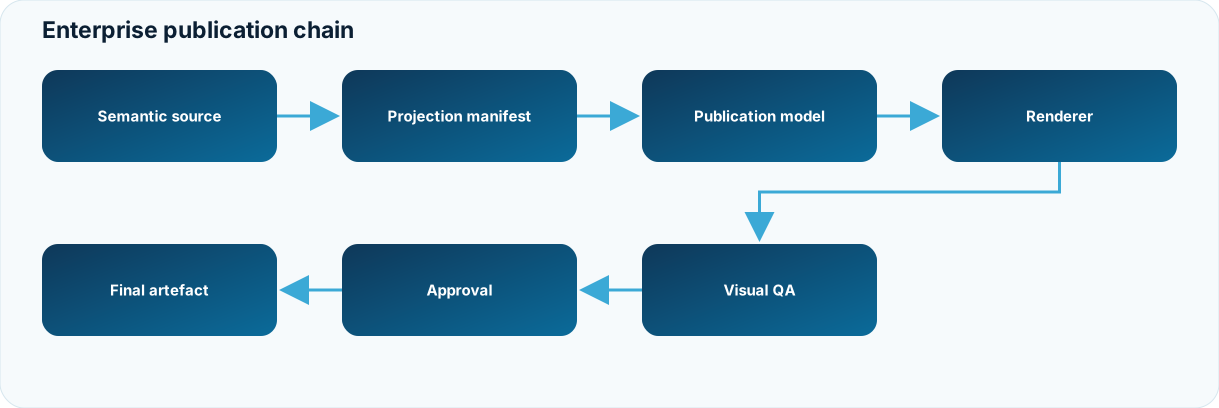
26.10.4 makes the chain profile-native:
L1 intended audience / decision / authorised use
  ↓
L2 semantic material available for publication
  ↓
L3 inclusion, omission, evidence and release rules
  ↓
L4 publication/document design
  ↓
L5 renderer and output implementation
  ↓
L6 rendered artefact + hashes + visual evidence
ProjectionManifest v3
The manifest binds the publication to both JAI lineage and content identity. It carries the relationship between:
- intent;
- semantic snapshot;
- policy;
- design;
- realisation;
- evidence;
- semantic/projection/render hashes.
The production renderer validates the matching manifest before emitting the supported current-release artefact.
Why the projection layer matters
A single semantic source may be used to create an executive one-pager, ARB pack and technical design. Those documents should not all contain the same detail, but each must be able to demonstrate that mandatory content for its audience/use was included and that omissions were permitted rather than accidental.
Publication archetypes
The release ships thirteen first-class archetypes, including:
- Executive One-Pager;
- Decision Paper;
- Architecture Review Board Pack;
- Architecture Definition;
- Solution Design / HLD;
- Detailed Design / LLD;
- Risk & Assurance Pack;
- Implementation Specification;
- Migration & Cutover Pack;
- Operational Handover;
- Roadmap;
- Benefits Review;
- Audit / Compliance Evidence Pack.
Output formats
The publication stack supports first-class enterprise outputs such as HTML, DOCX, PPTX and XLSX, with PDF/SVG/EA interchange used where the relevant renderer/profile applies.
For SABSA documentation, Markdown is the default. Explicit LaTeX source and DOCX requests use Pandoc; compiling the LaTeX PDF additionally needs XeLaTeX, TeX packages and fonts. Office rendering for visual QA is a separate optional dependency from DOCX generation. See sandbox and environment prerequisites for the dependency/access matrix and deployment notes for controlled build qualification.
Semantic, projection and render identity
Do not collapse the three hashes:
semantic_hash   = what the approved semantic source was
projection_hash = what this audience/use was supposed to receive
render_hash     = the exact emitted file
The separation is essential for detecting both content omission and post-render file changes.
Visual QA
Render-based visual QA checks the visible result after rendering. It complements, rather than replaces, semantic review and ProjectionManifest coverage checks.